





The Causes & Effects of Production Downtime
Industrial ice production downtime can be caused by water-supply problems, refrigeration faults, restricted airflow, mechanical wear, electrical issues, faulty sensors or problems with ice storage and distribution.
Downtime can also occur when an ice system has not been sized correctly for peak production demand or has not received regular preventative maintenance.
However, it is important to distinguish genuine downtime from normal operation.
Flake ice machines are designed for continuous operation. They produce ice for as long as there is demand and storage capacity available. Once the storage bin is full, the system pauses automatically and restarts when the ice level drops. A machine that has stopped because its storage bin is full has not broken down.
What Is Industrial Ice Production Downtime?
Industrial ice production downtime is a period when a facility requires ice, storage capacity is available, but the system is unable to produce or deliver the required amount.
Downtime may involve a complete machine shutdown. It may also involve a partial loss of performance where the machine continues running but produces ice more slowly than expected.
Examples of genuine downtime include:
- A machine that will not start despite a low storage level.
- A refrigeration fault that stops ice production.
- A water-supply problem that prevents the machine from operating.
- A mechanical failure within the ice-making or discharge system.
- A control-system fault that keeps the machine unavailable.
- A blocked conveyor or storage system that prevents ice from being delivered.
- Production output falling below the level needed by the facility.
By contrast, a full-bin pause is part of the machine’s normal automatic control cycle.
1. Problems With the Water Supply
An industrial ice machine needs a consistent supply of suitable water. Any problem that restricts the water entering the machine can reduce output or stop production completely.
A machine may initially display a low-water warning. If the required water conditions are not restored, the control system may prevent the machine from starting or stop it during operation.
Water quality also affects long-term reliability. Mineral deposits can restrict water flow and reduce the efficiency of ice-making surfaces. Ice Systems recommends regular water-filter replacement to help maintain ice quality and prevent limescale build-up.
Operators should check accessible valves, filter indicators and visible pipework. Internal water components should be inspected by an appropriately trained engineer.
2. Refrigeration System Faults
The refrigeration system removes heat from the water so that ice can be produced. A problem within this system can reduce production or cause the machine to stop.
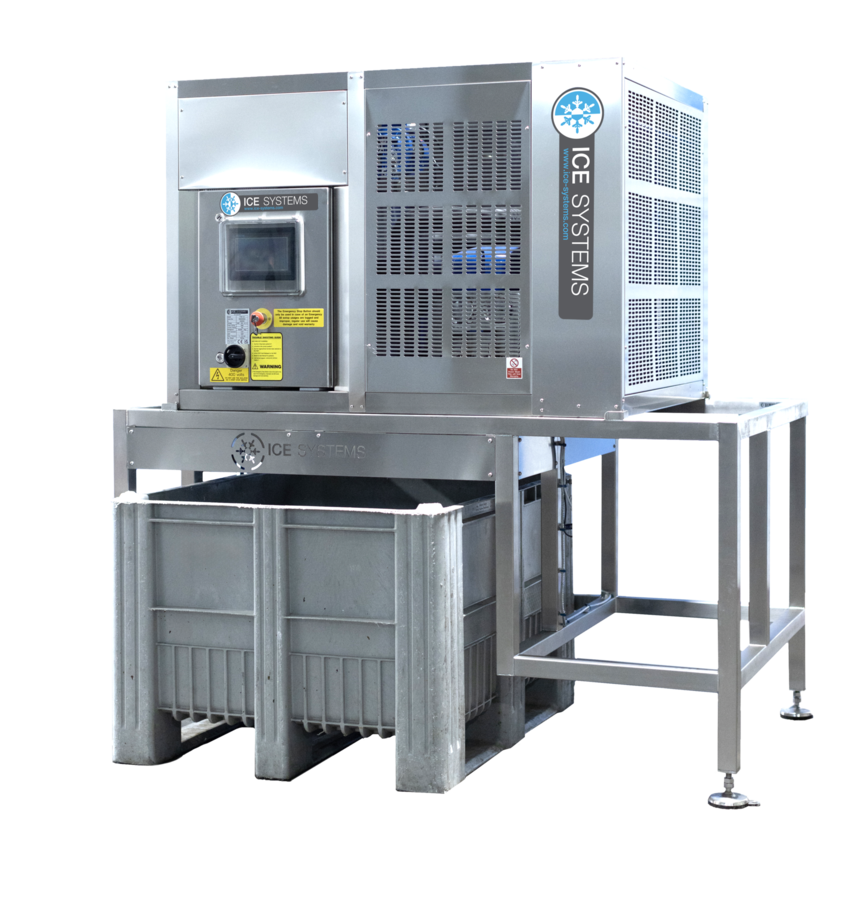
Industrial refrigeration equipment may include:
- A compressor
- A condenser
- An evaporator or ice-making cylinder
- Refrigeration valves
- Fans or pumps
- Pressure and temperature controls
- Refrigerant pipework
- Electrical protection devices
Possible warning signs include refrigeration alarms, unusually long running periods, reduced output or repeated protective shutdowns.
The machine’s control system may stop production if pressure or temperature moves outside its approved operating range. This is intended to protect the equipment from further damage.
Refrigeration alarms should not be repeatedly reset without investigation. Industrial ice machine service programmes typically include checks of compressors, condensers, evaporators and associated refrigeration components.
3. Restricted Airflow or High Ambient Temperatures
Industrial ice machines produce heat as part of the refrigeration process. That heat must be removed effectively.
Where an air-cooled condenser is used, restricted airflow can cause operating temperatures and pressures to rise. Possible causes include blocked ventilation openings, a failed condenser fan or high temperatures around the equipment.
A machine may continue running under warmer conditions but produce ice less efficiently. If conditions become too severe, a protective refrigeration control may stop the system.
Ice Systems confirms that industrial flake ice machines can operate in high-temperature environments, although output efficiency may fall slightly and adequate ventilation becomes more important.
The area around the machine should therefore remain clear and well ventilated. Internal condenser cleaning and refrigeration work should be completed by qualified personnel.
4. Mechanical Wear or Blockages
Industrial ice systems contain motors, bearings, drives, pumps and other moving components. These parts are subject to wear during normal operation.
Mechanical downtime may be caused by worn bearings, a damaged motor or gearbox, ice obstructing the discharge point or a pump failure.
Early signs can include new noises, increased vibration, motor-overload alarms or a gradual reduction in production. A machine should not be opened or dismantled while it is operating. Grinding, scraping, knocking or other unusual mechanical sounds should be reported and investigated safely.
Routine servicing allows wear to be identified before a component fails completely. We recommend that motors, bearings, drive systems and other moving parts should be inspected so that worn components can be replaced during planned maintenance.
5. Electrical and Control-System Faults
Electrical and control components manage the machine’s operating sequence. A failure may prevent the machine from starting even when the refrigeration and mechanical systems are otherwise available. These faults can be caused by a tripped circuit breaker, a blown fuse, or a damaged electrical connection.
The control panel should indicate why the machine has stopped. Operators should record the complete alarm message rather than simply reporting that the machine is not working.
Technical setpoints and electrical protection devices should only be adjusted by authorised personnel. Bypassing an electrical or safety control may damage the machine and create a serious safety risk.
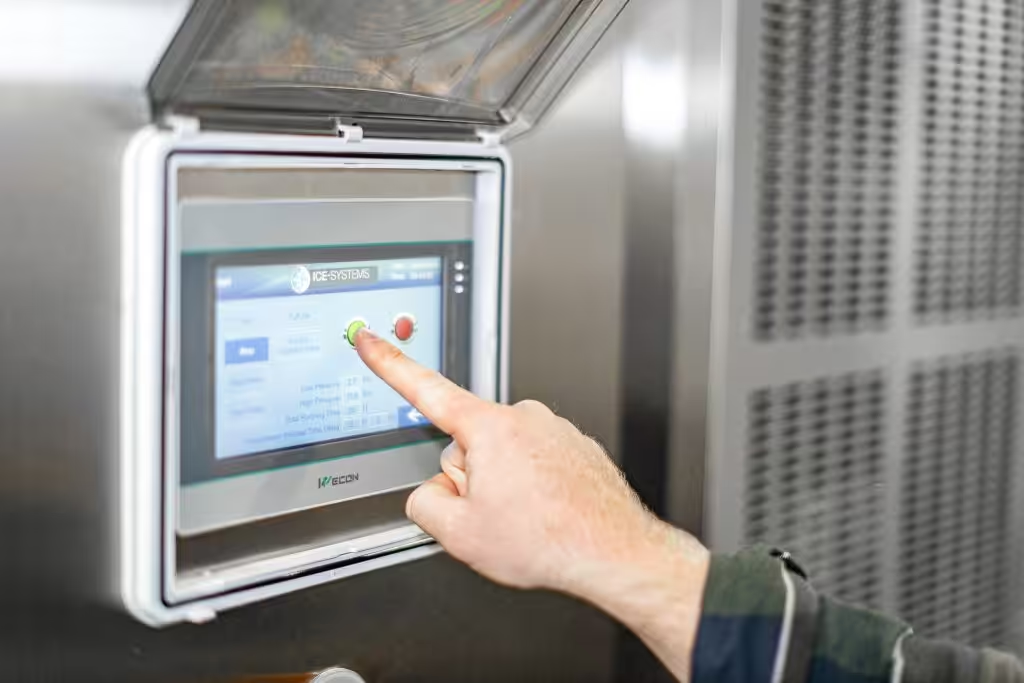
Our industrial ice machines use HMI touchscreens for production control, including timed programmes and automatic hygiene functions.
6. Faulty Ice-Level or Storage Sensors
Ice-level sensors tell the machine whether more ice is required.
When the storage bin reaches its upper level, the sensor tells the machine to pause. When the level drops, the demand signal returns and production restarts.
A sensor problem can disrupt this process. For example, a dirty sensor may incorrectly detect a full bin, or fail to notice that the ice level has fallen. A sensor may also have moved out of position, or the control system may not be receiving the sensor signal.
The result may be a machine that stops too early, fails to restart or continues running when the storage area is already full.
Operators should first confirm the actual ice level and compare it with the status shown on the control panel. Sensors should be cleaned and inspected according to the machine instructions, but they should not be repositioned without knowing their correct setting.
7. Storage and Ice-Distribution Problems
The ice machine is only one part of the complete system. Ice may also need to pass through a storage bin, hopper, chute, conveyor or another distribution arrangement.
A problem with any of these components can interrupt production.
In an integrated installation, the ice machine may be designed to stop when downstream equipment is unavailable. This prevents ice from overflowing or accumulating around the discharge point.
Storage and distribution equipment should therefore be included in fault-finding and preventative maintenance. Commissioning should confirm that the machine, storage bin and distribution system operate correctly together.
8. Scale, Dirt and Inadequate Cleaning
Industrial ice machines operate with water and are often installed in demanding food-production environments. Without correct cleaning and water treatment, deposits can develop within the system.
Scale can reduce heat transfer and restrict water flow. The machine may need to run longer to produce the same amount of ice, increasing the risk of reduced output and eventual downtime.
Cleaning should follow the manufacturer’s instructions and the facility’s hygiene procedures. Strong chemicals, pressure washing or unsuitable cleaning methods can damage sensors, seals and electrical equipment.
9. Missed Preventative Maintenance
Waiting until an industrial ice machine fails is rarely the most effective maintenance strategy. Preventative maintenance allows many issues to be corrected during a planned maintenance window rather than during a busy production shift.
We offer annual and multi-year service agreements, fixed-price servicing, FGAS checks, telephone support and on-site engineering assistance. Rental machines include routine servicing as part of the rental arrangement.
10. Demand Exceeding the System’s Capacity
A lack of available ice does not always mean the machine has broken down.
The machine may be operating correctly but unable to produce ice as quickly as the facility is using it. This can happen when:
- Production volumes increase.
- Additional shifts are introduced.
- Seasonal demand rises.
- More processing lines begin using the same ice supply.
- Storage capacity is too small.
- The system was sized using average rather than peak demand.
- The machine’s performance has not been reassessed following business growth.
In this situation, the operational result can feel like downtime because production does not have enough ice. However, the underlying problem is insufficient production or storage capacity rather than a mechanical fault.
Ice Systems supplies industrial flake ice machines with published capacities between 600kg and 9,000kg per 24 running hours. Correct machine selection should consider daily requirements, shift patterns and peak demand rather than average usage alone.
11. External Site Problems
Some causes of downtime originate outside the ice machine. For example, a building-wide power failure, voltage or phase problems, damage to network or control connections or a problem with upstream or downstream production equipment. The machine may display an alarm even though the original cause is elsewhere in the facility.
When investigating downtime, operators should check whether other equipment has also been affected. This can help distinguish between a machine-specific problem and a wider site issue.
How Can Ice Production Downtime Be Reduced?
Not every equipment failure can be prevented. However, facilities can reduce both the likelihood and duration of downtime through consistent operating and maintenance practices.
- Understand Normal Operation
Operators should know that a full storage bin causes a normal automatic pause. They should also understand the machine’s usual sounds, filling time, running pattern and control-panel messages.
- Record Repeated Alarms
The alarm message, time and operating conditions should be recorded. A recurring warning should be investigated, even when the machine restarts successfully.
- Monitor Ice Output
A gradual reduction in output can provide early warning of a water, refrigeration or mechanical problem. Facilities can monitor how long the system takes to refill its storage bin and compare performance under similar production conditions.
- Replace Filters as Required
Water filters should be replaced according to the recommended schedule. A restricted filter can affect water flow, machine performance and ice quality.
- Keep the Area Clear
Ventilation openings and condenser areas should not be obstructed by packaging, pallets or other equipment.
- Arrange Preventative Servicing
Planned servicing allows refrigeration, water, mechanical, electrical and control components to be checked before a fault stops production.
- Maintain Accurate Fault Information
When contacting an engineer, provide:
- The machine model.
- The exact alarm message.
- The time the problem began.
- Whether the storage bin is full or low.
- Whether the machine attempted to restart.
- Any unusual noise, vibration or leakage.
- Details of any recent maintenance or site changes.
Accurate information can reduce diagnostic time and help the service engineer prepare for the required work.
Why Downtime Matters in Food Production
For many industrial facilities, ice is part of the production process rather than a general convenience.
In meat processing, an interruption to ice availability may affect temperature control, production schedules and product quality. Ice Systems notes that industrial flake ice machines in these environments are designed for continuous operation and that machine sizing should reflect peak usage.
In the seafood industry, ice may be required during unloading, processing, packing, storage and transport. An interruption can therefore affect several stages of the operation.
This is why a downtime plan should consider more than repairing the machine. It should also consider available stored ice, alternative production capacity, service support and how the facility will protect its production process while the fault is resolved.
Maintaining Reliable Industrial Ice Production
Ice production downtime can result from water restrictions, refrigeration faults, mechanical wear, electrical problems, faulty sensors, blocked storage equipment or inadequate maintenance.
A shortage of ice may also occur when production demand has grown beyond the machine or storage system’s available capacity.
The first step is always to confirm whether the machine has genuinely failed. A flake ice machine that pauses because its storage bin is full is operating normally. It should restart automatically when the ice level drops and more storage capacity becomes available.
Where genuine downtime occurs, accurate alarms, trained operators, regular servicing and responsive engineering support can reduce the length and operational effect of the interruption.
Explore our range of industrial flake ice machines or learn more about our wider industrial ice machine supply, installation and support.
Frequently Asked Questions
What is the difference between an ice machine pause and downtime?
A normal pause occurs when the storage bin is full and no more ice can be stored. The machine should restart automatically when the ice level falls. Downtime occurs when ice is required and storage capacity is available, but the system cannot produce or deliver it.
Can low water pressure stop an industrial ice machine?
Yes. An industrial ice machine requires a consistent water supply. Low pressure, a blocked filter, a closed valve or another water restriction may reduce output or cause the control system to stop production.
Can hot conditions reduce industrial ice production?
High ambient temperatures and poor ventilation can reduce production efficiency. Restricted condenser airflow may also cause refrigeration pressures to rise, potentially leading to a protective shutdown.